What is the Most Effective Water Treatment?

Selecting the ideal water treatment solution is crucial for safeguarding ecosystems, protecting public health, and complying with regulatory standards. Effective water treatment not only mitigates environmental harm but also conserves precious water resources for future generations.
Whether addressing industrial or domestic wastewater, choosing the right treatment method requires a deep understanding of available technologies, site-specific requirements, and key factors like cost, efficiency, and environmental impact. This guide provides a comprehensive breakdown of the critical steps, processes, and distinctions between major treatment methods. It equips engineers, plant managers, and decision-makers with the knowledge and tools needed to make informed, sustainable choices that support long-term objectives.
What Are the Steps in Industrial Wastewater Treatment?
The industrial wastewater treatment process addresses various pollutants, ensuring treated water meets reuse or discharge standards. The method varies depending on the origin and composition of wastewater. Key stages include:
- Preliminary Treatment: Screens and grit chambers remove large particles and prepare wastewater for processing. This stage may also include pH adjustment to neutralize acidic or alkaline conditions before the water enters biological or chemical treatment.
- Primary Treatment: Suspended solids and some organic materials are removed using sedimentation tanks or clarifiers, which allow particles to settle out by gravity. In addition to sedimentation, physico-chemical processes such as Dissolved Air Flotation (DAF) are often employed. DAF systems release fine air bubbles that attach to solids, causing them to float to the surface, where they can be skimmed off. GEM systems, a more advanced form of DAF, offer improved flotation efficiency and are especially useful in industries with high concentrations of solids, fats, or grease.
- Secondary Treatment: Biological processes, such as activated sludge systems or biofilm reactors, break down dissolved organic material.
- Tertiary Treatment: Advanced filtration, disinfection, or chemical treatments are applied to remove fine particles and remaining contaminants.
Each step plays a critical role, with the sequence and methods varying based on the type of industrial wastewater and its specific contaminants. These tailored processes ensure that treatment systems effectively address unique challenges and achieve optimal outcomes.
What Are the Stages of Water Treatment?
Both municipal and industrial water treatments revolve around ensuring purification and safety, typically handled in several steps:
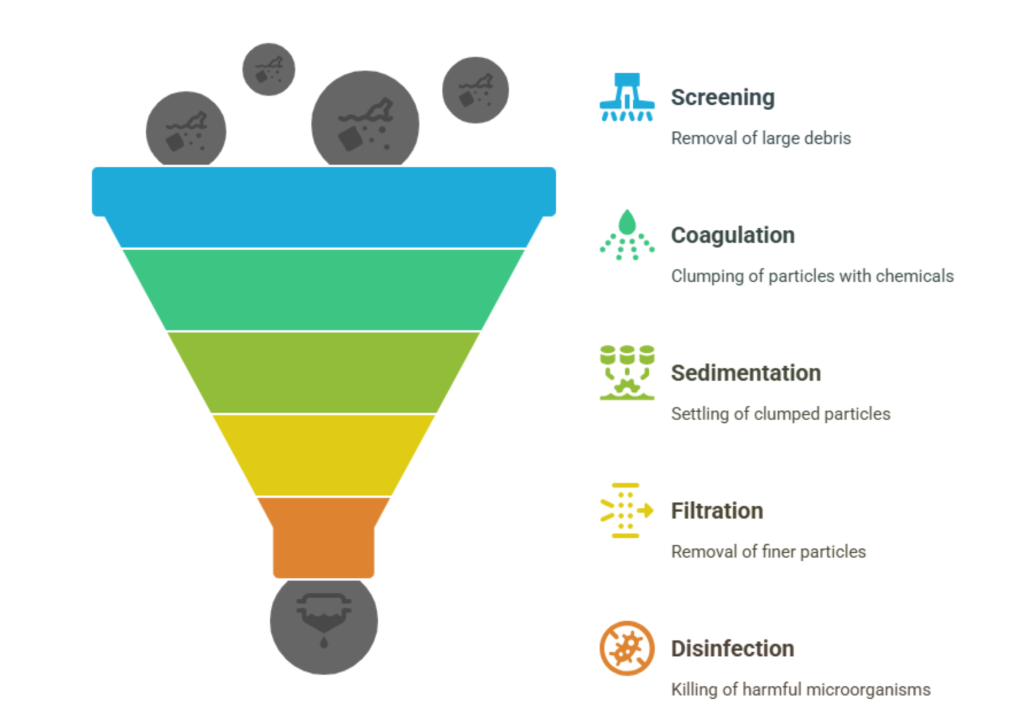
- Screening: Large debris, such as leaves and plastic, is removed.
- Coagulation: Chemicals like alum are added to clump smaller particles into larger clusters.
- Sedimentation/coagulation/flotation: Waste particles attach to air bubbles and polymers, forming flocs that rise to the surface and can be skimmed off. The overall result is the effective separation of solids and liquids.
- Filtration: Materials like sand or activated carbon filter out finer particles.
- Disinfection: Chlorine, ozone, or UV light effectively kills harmful microorganisms.
- Storage: Treated water is placed in reservoirs for further use.
- Distribution: Sometimes, water is delivered through pipelines to homes and businesses.
These stages form the backbone of large-scale purification efforts, whether applied to domestic wastewater or more complex cases involving industrial wastewater. While the fundamental principles remain, industrial facilities often require more advanced and customized technologies.
What Is the Difference Between Industrial Waste and Municipal Waste?
The sources and characteristics of industrial waste and municipal waste differ significantly, necessitating varied treatment strategies.
- Industrial Waste: Arising from manufacturing or industrial activities, this waste often contains hazardous substances like heavy metals, oils, and chemicals. Its composition may also include non-biodegradable materials requiring specialized treatments such as chemical neutralization, evaporation, or membrane filtration.
- Municipal Waste: Commonly referred to as domestic effluent, it is generated by households and involves a mix of organic waste, greywater, and biodegradable materials. The treatment of domestic effluent emphasizes simpler biological or physical processes. Determining how domestic effluent gets into the water source is key to addressing environmental impact.
Understanding such differences ensures proper resources and methods are allocated to treat each waste type effectively.
What are the Different Methods for Treatment of Municipal Waste and Industrial Effluents?
Treating municipal waste and industrial effluents requires a combination of conventional and advanced methods, each suited to specific contexts. The choice of treatment depends on factors such as the nature of contaminants, reuse goals, and compliance with environmental regulations. Below, we compare key treatment methods to help determine the most effective solutions for various scenarios.
Conventional Methods:
- Activated Sludge: A widely used biological treatment for both municipal and industrial wastewater. It effectively removes organic matter but may struggle with high-strength industrial effluents.
- Chemical Treatment: Includes coagulation, flocculation, and flotation methods such as Dissolved Air Flotation (DAF) to remove suspended solids, fats, oils, and certain dissolved pollutants. While pH adjustment is typically part of the pre-treatment phase, chemical treatment remains effective for targeting specific contaminants like heavy metals. These processes often generate chemical sludge that requires proper disposal.
- Sand Filtration: Common in municipal treatment for removing particulate matter. Works well as a preliminary step but may not address finer pollutants.
Advanced Treatment Methods:
- Advanced Treatment Technologies: Membrane Bioreactors (MBRs) are one of several advanced treatment options, combining biological processes with membrane filtration to produce high-quality effluent suitable for reuse—especially in industries with stringent discharge standards. However, MBRs are often part of a broader treatment train. For example, anaerobic reactors like UASB (Upflow Anaerobic Sludge Blanket) or EGSB (Expanded Granular Sludge Bed) can be used as a first stage, removing up to 80% of dissolved solids, followed by aerobic systems such as MBR, MBBR (Moving Bed Biofilm Reactor), or SBR (Sequencing Batch Reactor) to further reduce contaminants. The combination of anaerobic and aerobic systems is common in industrial wastewater treatment to maximize efficiency and meet regulatory requirements.
- Reverse Osmosis (RO): Advanced filtration technique for removing dissolved salts and impurities. Suitable for water reuse in industrial processes.
- UV Disinfection: Effective for eliminating pathogens in municipal and industrial wastewater. Best used in tandem with other methods for comprehensive treatment.
- Zero-Liquid Discharge (ZLD) Systems: Highly sustainable option that recycles water and minimizes waste, suitable for industries aiming to reduce environmental impact.
Which Methods Are Most Effective?
- Municipal Wastewater: Activated sludge and chemical methods are effective for large-scale treatment, with MBR and UV disinfection offering advanced solutions for reuse.
- Industrial Effluents: For high-strength waste, industrial facilities may incorporate advanced treatment technologies such as Reverse Osmosis (RO), Membrane Bioreactors (MBR), or Zero Liquid Discharge (ZLD) systems. While not the most common solutions, these methods are employed in cases where strict regulatory standards or specific sustainability goals require high levels of contaminant removal and water recovery.
By leveraging these methods of water treatment, industries and municipalities can adopt tailored solutions that balance cost, efficiency, and environmental responsibility.
Not Sure Which Treatment Is Most Effective for Your Facility?
Start with our free Wastewater Survey. It takes about 5 minutes, and our engineers personally review your results to help identify the right treatment approach for your facility.
Conclusion
Efficient water treatment is crucial for industrial sustainability, regulatory compliance, and environmental protection. By leveraging advanced technologies such as preliminary, primary, secondary and tertiary treatment, reverse osmosis, UV disinfection, and zero-liquid discharge systems, industries can manage their water resources more effectively and responsibly.
These innovative solutions not only ensure compliance with regulations but also minimize environmental impact and promote resource conservation. Investing in cutting-edge water management systems goes beyond meeting immediate requirements, it future-proofs your business and supports a healthier planet. Embrace sustainability today by adopting eco-friendly water management strategies, securing lasting benefits for your business, your community, and the environment.
Take the first step toward a sustainable future by discovering innovative solutions for advanced water management today! Learn how Clan Water Technology can help your facility implement the most effective treatment solution. Explore our Industrial Wastewater Treatment process to find the system that fits your unique needs.
Disclaimer
The information in this article is provided for general educational purposes and to promote overall awareness. It is not intended as engineering, legal, or other professional advice, and should not be used in place of consultation with qualified professionals familiar with your specific application and conditions. This content should not be considered exhaustive.