
INDUSTRY SOLUTIONS FOR WASTEWATER TREATMENT
INDUSTRIAL MINING
WASTEWATER SOLUTIONS
A renowned Acid Mine Drain (AMD) wastewater plant achieves very low residual heavy metal concentrations by switching to the GEM System and walnut filters, resulting in significant cost savings, drier sludge, improved removal rates, and a smaller footprint.
CASE STUDY
Acid Mine Drain (AMD) Treatment Achieves Very Low Residual Heavy Metal Concentrations
MINING INDUSTRY WASTEWATER SOLUTIONS
The Client’s wastewater treatment plant currently treats about 450,000 gallons per day (gpd) of acid mine drain (AMD) water collected into several collection ponds. The plant, operating 9 hours, 5 days a week, uses the standard lime hydroxide precipitation process at pH 10.7 to precipitate heavy metals and remove AMD contaminants in 3 large, dissolved air flotation (DAF) units followed by sand filtration.
Challenge
With the potential opening of a new molybdenum mine at the same site, client wants to upgrade their current system and reduce costs where possible. Plant personnel explained that they needed three DAFs so two could run at the same time with a spare available when they perform maintenance or cleaning.
Upcoming plant modernization goals:
- Replace large DAF units with smaller footprint and expandable systems for solid/liquid separation; space will be needed if a new molybdenum mine opens.
- Replace sand filters with walnut filters to save on backwash water.
- Test for possible use of the high-density sludge (HDS) to achieve higher solids loadings to save on sludge disposal costs.

Solution
Pilot test with the GEM® System:
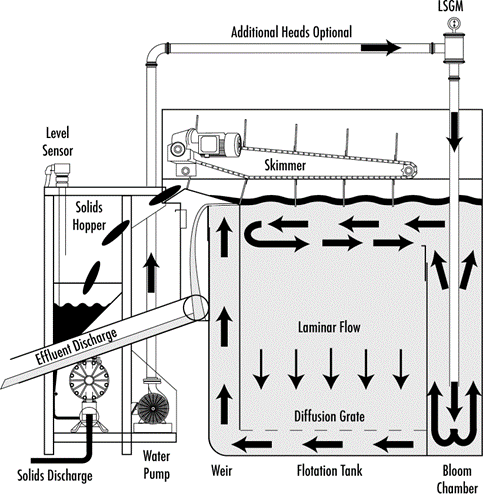
The GEM System’s hybrid centrifugal DAF unit has been used to replace or retrofit existing DAFs. 90% smaller and more efficient than a DAF, the client wanted to verify results in the field.
During the demonstration, CWT performed onsite testing to measure reductions of TSS, NTU (turbidity), COD, and % solids of the sludge after GEM treatment. A complete analysis was performed to determine optimal treatment efficacy of chemical usage, sludge dryness, and contaminant removal rates.
CWT Industrial Wastewater Leaders
Conclusion
The GEM System utilizes lime precipitation at pH 10.7 and dual granular flocculant flocculation-flotation to consistently reduce total suspended solids (TSS) to <10 ppm, cadmium to <10 ppb, and zinc to <1 ppm. Ferric and aluminum are typically reduced to around 1.2 ppm.
Lead, silver and copper were reduced close to nondetectable levels. Walnut filters removed all heavy metals with cadmium to <0.5 ppb, zinc to < 0.3 ppm, ferric and aluminum to <0.5 ppm, and TSS to less than 1 ppm. Only 5% of clean water had to be used for walnut filter washing, as opposed to 43% when using current sand filters. The GEM system produced sludge with around 3% dry solids, sludge could be filter-pressed without any additional flocculant.

Reductions
Demonstration tests indicated that the GEM System reduced, on average:
- Turbidity (NTU) by approximately 99.5%
- TSS by approximately 98%
- Cadmium by approximately 97.5%
- Zinc by approximately 97.5%
- Iron by approximately 98%
- Manganese by approximately 97%
GEM vs. DAF
- The GEM sludge was approximately 3% solids before decant and 16% after filter press.
- No additional chemistry was necessary for the GEM solids to dry in the filter press.
- In the GEM System, only 2-5 ppm of dual polymers were used.
- No surfactants, thus no defoamer, are used in the GEM System. The compressed air into the GEM System is 100% natural air.
- The DAF sludge required 400 ppm of flocculants to create successful dryness in the filter press.
- By switching to the GEM System and walnut filters, the client realizes great cost-savings in chemical usage, drier sludge, better removal rates, future expansion capabilities, and a significantly smaller footprint.
Additional Findings
There was not enough iron or oxygen in the water to precipitate all heavy metals by co-precipitation with iron (III) hydroxide.
- To add more iron to the influent, CWT recycles the sludge into a lime-sludge mixing tank or directly into client’s existing lime/AMD reactor. This provides an appropriate increase in iron without additional chemical costs.
- Lack of oxygen in the water can accelerate the precipitation of Iron II by oxidizing it to iron (III), which is 10 times less soluble and precipitates faster out of water.
Enough ferric (III) hydroxide with AMD influent and NO chemical addition will yield success. After rounds of sludge recycling, Client should see an increase in sludge density, due to the increased iron. To oxygenate AMD influent before the lime addition, we recommend using the GEM System’s LSGM hydrocyclone with compressed air to oxidize the manganese and iron (II) hydroxide stream completely. This energy-efficient approach can reduce the retention time needed to fully precipitate iron and prevent solids from carrying over to Client’s effluent. Iron (II) ions slowly oxidize in the effluent and produce iron (III) hydroxide that coats sand or walnut shell filter media.
The DAF’s should be replaced with two GEM Systems which, at 90% smaller, can treat the same amount of water as the DAFs and still achieve better results using fewer chemicals. Sand filters should be replaced with walnut filters to save backwash water and energy. Sand filters use up to 50% of produced water for backwash, walnut filters 3-5 %. Removal of heavy metals is similar with sand filters performing slightly more efficiently, (15-20% better removals).
Ask For Your Free Wastewater Analysis (Kit)
Talk to an expert about wastewater solutions for the food industry and see how we can help you increase your bottom line. CWT is a global provider of innovative wastewater system solutions.
Schedule Your Consultation
Discover what hundreds of facilities all over the globe already know.
Clean Water Technology is your #1 solution for wastewater treatment.
